
JournalContrast8 min read
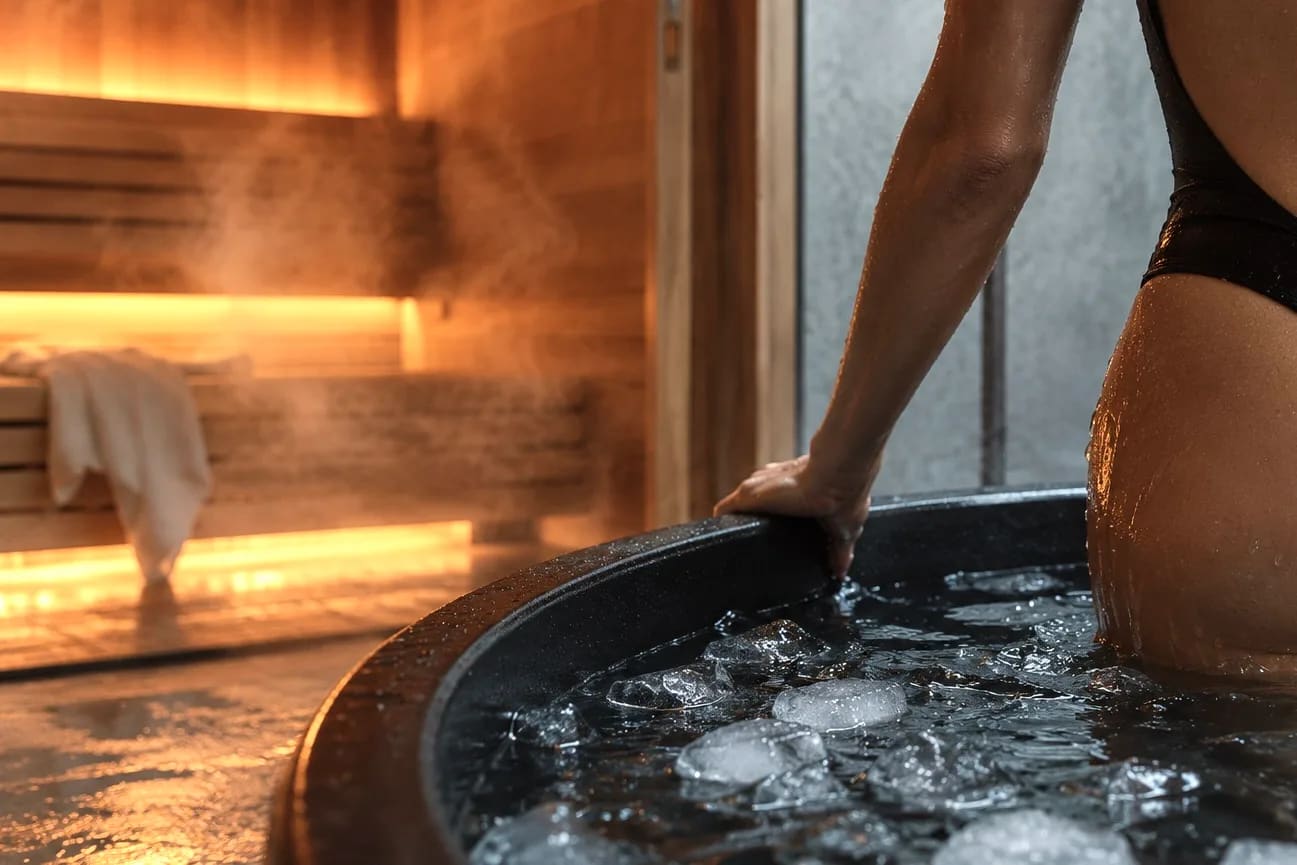
Sauna and ice bath each have their own effect. Alternating between them is therefore no exotic third method. It is the way to get both adaptations in one session instead of having to choose. This article explains what happens physiologically and why the order is anything but arbitrary.
What contrast therapy is
Contrast therapy means the controlled alternation of heat and cold exposure within one session. In the research literature usually as contrast bathing, in practice usually as a sauna followed by an ice bath or cold plunge. Several cycles within 10 to 20 minutes are typical.
What makes the method special is that your body has to run two opposing regulatory programmes within minutes, and in doing so it trains exactly the flexibility that characterises a well regulated nervous system.
Two stimuli, two adaptations, one session
The strongest argument for contrast is the simplest one. Heat and cold work through different routes and trigger different adaptations. Do only one of them and you get only one of the two effects.
What the heat contributes
- Vascular function: in a controlled eight week study, flow mediated dilation, the standard marker of endothelial function, rose from 5.6 to 10.9 percent, arterial stiffness fell and blood pressure dropped by 5 mmHg (Brunt et al., 2016).
- Heat shock proteins: the cellular repair machinery ramps up and stays better prepared over time.
- Plasma volume: rises with regular heat exposure, in competitive runners by 7.1 percent, together with clearly improved endurance performance (Scoon et al., 2007).
- Long term associations: in the Finnish KIHD cohort, frequent sauna use over 21 years was linked to markedly lower cardiovascular and all cause mortality (Laukkanen et al., 2015).
What the cold contributes
- Muscle soreness and perceived recovery: meta-analytically established. Less soreness, lower creatine kinase at 24 hours, a faster sense of recovery (Xiao et al., 2023).
- Parasympathetic reactivation: cold immersion after exertion measurably speeds the nervous system's return to recovery mode (Ottone et al., 2014).
- Cold adaptation: regular cold changes heat production. Winter swimmers generate heat far more efficiently than untrained people during cold exposure (Søberg et al., 2021).
- Stress levels: a meta-analysis of eleven randomised trials with 3,177 participants found a clear reduction in stress, usually appearing around twelve hours later (Cain et al., 2025).
The order is anything but arbitrary
This is where it gets interesting. A Finnish study with 93 participants who had cardiovascular risk factors measured heart rate variability before, during and after a 30 minute sauna at 73 degrees. The result: the decisive parasympathetic switch happened not during the heat but in the cool down phase afterwards. Heart rate fell from 77 to 68 beats per minute, the low frequency component decreased and the high frequency component, the marker of vagal activity, rose clearly (Laukkanen et al., 2019).
That is why a session at CYRCL follows a fixed sequence:
- 15 minutes of sauna. The heat sets the stimulus.
- Two to three rounds in the ice bath, with time in between to breathe and acclimatise. The switch challenges your circulation and trains your breath control.
- 15 minutes of sauna. The second heat stimulus, now on a body that has already made the shift.
What people claim, and what the data supports
The most common explanation for contrast therapy is the so called vascular pump. Alternating constriction and dilation is said to act like a pump and clear metabolic by-products faster. The image is catchy, and the data behind it is weaker than its popularity suggests. Studies that measured arterial blood flow directly during the application could not consistently show the expected fluctuations at depth, and the temperature in deeper muscle tissue changes considerably less than the model assumes.
For you as a user that changes little, though it does change the reasoning. The solid case for contrast is not a hypothetical pump. It is the sum of two individually well documented stimuli, plus an autonomic switch during the cool down phase that can be measured directly.
An honest note that few people make: almost the entire research literature on contrast therapy uses contrast baths, with cold water around 10 to 15 degrees and warm water around 38 degrees. Studies looking specifically at the combination of an 80 to 90 degree sauna with an ice bath are rare. The individual effects of heat and cold are well documented, but the exact effect sizes from the water bath studies cannot be transferred one to one to sauna and ice.
Safety
Contrast therapy is well tolerated, though in the acute phase it is a cardiovascular load rather than a relaxation method. So:
- With known cardiovascular disease, arrhythmia or untreated high blood pressure, the decision belongs with your doctor.
- No alcohol before or during the session.
- Never go into the cold alone.
- No breath holding exercises in or right before the cold water.
- Drink enough. Fluid loss through the heat is considerable.
- Sit it out during an acute febrile infection.
What this means for you
Contrast therapy is a format in which two individually well studied stimuli are placed one after the other, in a sequence that follows your physiology: stimulus, switch, stillness.
That is exactly how the Contrast area at CYRCL is built. Around 60 minutes, guided or self-directed, in three formats with different intentions:
- Reborn in the morning, activating. Shorter heat phases, stronger cold stimuli, breathwork that wakes you up.
- Reset at midday, balancing. Even cycles, focused on returning you to a workable state.
- Relax in the evening, winding down. Longer heat phases, longer rest phases, extended exhales.
What role the accompanying breathwork plays, and why it is far from an add on, is the subject of the next article in this series.
Frequently asked questions
What is contrast therapy?
Contrast therapy is the controlled alternation of heat and cold exposure within one session, classically a sauna followed by cold water, and in studies usually contrast bathing. The benefit lies in the fact that heat and cold work through different routes, so one session triggers both adaptations.
Should you start with heat or with cold?
With heat. Heart rate variability measurements show that the nervous system switches into parasympathetic recovery mode not during the heat but in the cool down phase afterwards. Cold therefore belongs at the end of the cycle, followed by a rest phase.
What does contrast therapy do after training?
A meta-analysis of 18 studies with 356 participants shows less muscle soreness at all time points compared with passive recovery, plus better preserved strength and power, with standardised effect sizes of 0.75 for strength at 24 hours and 1.39 for power at 48 hours. The authors also point out the limited methodological quality of the underlying studies.
How often should you do contrast therapy?
Two to three sessions per week is a realistic and well tolerated frame. The effects of heat and cold build up cumulatively across weeks.
Does contrast therapy make sense after strength training?
Not immediately afterwards if muscle growth is the goal. Cold immersion straight after strength training demonstrably dampens muscle fibre growth. After endurance sessions this drawback does not appear.
Who should avoid contrast therapy?
With cardiovascular disease, arrhythmia or untreated high blood pressure, seek medical advice first, since the alternation changes heart rate and blood pressure sharply in the moment. No alcohol, never go into the cold alone, no breath holding exercises in cold water, and sit it out during a febrile infection.
Sources
- Bieuzen, F., Bleakley, C. M. & Costello, J. T. (2013). Contrast Water Therapy and Exercise Induced Muscle Damage: A Systematic Review and Meta-Analysis. PLOS ONE, 8(4), e62356.
- Versey, N. G., Halson, S. L. & Dawson, B. T. (2013). Water Immersion Recovery for Athletes. Sports Medicine, 43(11), 1101–1130.
- Versey, N. G., Halson, S. L. & Dawson, B. T. (2011). Effect of contrast water therapy duration on recovery of cycling performance: a dose–response study. European Journal of Applied Physiology, 111(1), 37–46.
- Laukkanen, T., Lipponen, J., Kunutsor, S. K., Zaccardi, F., Araújo, C. G. S., Mäkikallio, T. H., Khan, H., Willeit, P., Lee, E., Poikonen, S., Tarvainen, M. & Laukkanen, J. A. (2019). Recovery from sauna bathing favorably modulates cardiac autonomic nervous system. Complementary Therapies in Medicine, 45, 190–197.
- Radtke, T., Poerschke, D., Wilhelm, M., Trachsel, L. D., Tschanz, H., Matter, F., Jauslin, D., Saner, H. & Schmid, J.-P. (2016). Acute effects of Finnish sauna and cold-water immersion on haemodynamic variables and autonomic nervous system activity in patients with heart failure. European Journal of Preventive Cardiology, 23(6), 593–601.
- Ottone, V. O., Magalhães, F. C., Paula, F. et al. (2014). The Effect of Different Water Immersion Temperatures on Post-Exercise Parasympathetic Reactivation. PLOS ONE, 9(12), e113730.
- Cui, C., Chen, R., Ma, X. et al. (2024). The effects of hydrotherapy and cryotherapy on recovery from acute post-exercise induced muscle damage: a network meta-analysis. BMC Musculoskeletal Disorders, 25(1), 749.
- Brunt, V. E., Howard, M. J., Francisco, M. A., Ely, B. R. & Minson, C. T. (2016). Passive heat therapy improves endothelial function, arterial stiffness and blood pressure in sedentary humans. The Journal of Physiology, 594(18), 5329–5342.
- Laukkanen, T., Khan, H., Zaccardi, F. & Laukkanen, J. A. (2015). Association Between Sauna Bathing and Fatal Cardiovascular and All-Cause Mortality Events. JAMA Internal Medicine, 175(4), 542–548.
- Søberg, S. et al. (2021). Altered brown fat thermoregulation and enhanced cold-induced thermogenesis in young, healthy, winter-swimming men. Cell Reports Medicine, 2(10), 100408.
- Cain, T., Brinsley, J., Bennett, H., Nelson, M., Maher, C. & Singh, B. (2025). Effects of cold-water immersion on health and wellbeing: A systematic review and meta-analysis. PLOS ONE, 20(1), e0317615.
- Xiao, F. et al. (2023). Effects of cold water immersion after exercise on fatigue recovery and exercise performance: meta analysis. Frontiers in Physiology, 14, 1006512.
- Scoon, G. S. M., Hopkins, W. G., Mayhew, S. & Cotter, J. D. (2007). Effect of post-exercise sauna bathing on the endurance performance of competitive male runners. Journal of Science and Medicine in Sport, 10(4), 259–262.