
JournalCold8 min read
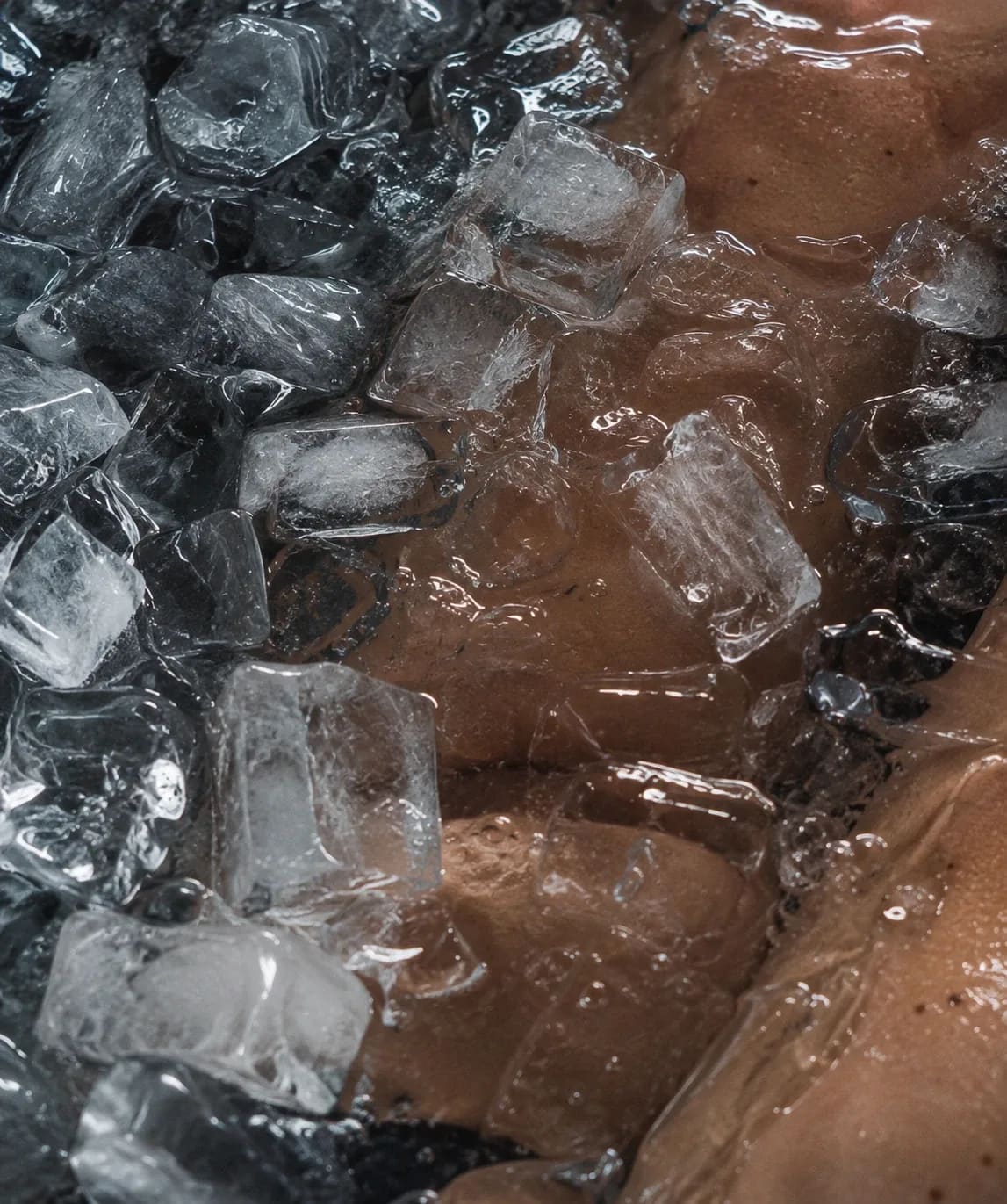
Cold is one of the few stimuli that work instantly and keep paying off for weeks. It lowers muscle soreness and stress markers, and it trains your ability to stay calm in an intense moment. Three things decide the effect: how cold, how long, and at what point you expose yourself.
What happens in the first seconds
Cold is an immediate stimulus. In the first seconds your body launches a fully automatic cascade:
- Vessels constrict. Blood moves out of skin and extremities into your core and protects your core temperature.
- Breathing reacts reflexively. A deep inhale, followed by faster breathing.
- Noradrenaline rises sharply. Attention, alertness and readiness to act shoot up.
- Metabolism ramps up. Your body produces heat and burns energy to do it.
Because these responses are so strong and so immediate, a few minutes in the cold are all you need.
What the ice bath does for you
Faster recovery after hard efforts
A meta-analysis of 20 studies with 419 participants shows that cold water immersion straight after training measurably reduces muscle soreness and perceived exertion, lowers creatine kinase levels at 24 hours and speeds up how recovered you feel (Xiao et al., Frontiers in Physiology, 2023).
In practice that means the days after an intense training block feel lighter. Exactly what counts when there is little time between two efforts.
Lower stress levels
A meta-analysis of eleven randomised controlled trials with 3,177 participants found a clear reduction in stress after cold water immersion. The timing is the interesting part: the effect was strongest around twelve hours after the session (Cain et al., PLOS ONE, 2025). The benefit unfolds across the day, so a morning plunge still pays off in the evening.
Better mood
A 2025 study followed 30 men, 15 of them regular winter swimmers, through immersion in 4 degree water. Among the experienced participants, mood improved measurably: less tension, less low mood, less fatigue (Teległów et al., 2025).
Your body learns the cold
Regular cold exposure changes your thermoregulation. A Danish study compared eight young winter swimmers, who had combined cold and sauna for at least two years, with eight controls. During cold exposure the swimmers produced markedly more heat than the control group. Their bodies had learned to heat more efficiently (Søberg et al., Cell Reports Medicine, 2021). The practical effect shows up fast: what feels overwhelming in week one becomes a matter of seconds of acclimatisation after four weeks.
Training for your nervous system
The most valuable effect may be the hardest to measure in a study and the easiest to notice in daily life. In cold water you are handed an intense stress response and you practise steering it with your breath. You train exactly the skill you need in a difficult conversation, right before a competition, or in a packed week: staying calm while your system ramps up.
Cold, but how cold?
The rule of thumb: the colder the water, the shorter the stay. Increase one of the two, never both. Most controlled studies work at around 10 degrees, and in that range the documented effects on soreness, recovery and stress appear reliably. Colder is always an option as long as you can handle it, and this is a place where meeting your limit is part of the point.
The right duration
- At 4 to 8 degrees: one to five minutes.
- At 10 to 15 degrees: ten to fifteen minutes.
- Per week: two to four sessions. Danish researcher Susanna Søberg derives a guideline of around eleven minutes of cold per week in total from her work.
- Afterwards: warm up actively through movement, jumping for example. Your core temperature keeps falling after you get out. This lag is called afterdrop, which is why the shivering often only kicks in properly a few minutes later.
Shorter is the smarter choice here. The effect comes from repetition across weeks, while the length of any single session matters less. That is why at CYRCL each guided session takes you into the ice bath three times for 90 seconds.
The right moment
When you use cold decides what it gives you. Sport science calls this principle periodisation of recovery (Ihsan, Abbiss & Allan, 2021). For you it means:
- After endurance sessions: straight away. Studies show endurance adaptations remain fully intact even with regular cold exposure.
- In competition phases and with tightly packed loads: ideal. Here the fast restoration of performance matters most.
- On recovery days and in high stress work phases: ideal. The benefit for your nervous system and stress levels takes centre stage.
- In building phases focused on muscle mass: go for heat straight after strength sessions and keep the cold rounds short. The inflammatory response after strength training is the signal for muscle growth, and immediate cold dampens it (Malta et al., Sports Medicine, 2021).
What matters in the cold
Cold deserves respect, and five rules make it manageable:
- Go with someone. The breathing reflex in the first seconds is the real risk factor, and a second person at the tub makes it manageable.
- Get in slowly and take control of your breathing first. Only submerge your shoulders once it runs calmly.
- Stay sober. Alcohol impairs thermoregulation and judgement alike.
- Breathing exercises with breath holds belong on dry land. Hyperventilation before immersion lowers CO₂ and with it your drive to breathe.
- With cardiovascular disease, arrhythmia, untreated high blood pressure or Raynaud's syndrome, seek medical advice first. Cold raises heart rate and blood pressure sharply in the moment.
What this means for you
Cold, brief, smart. Three words that sum up the entire body of evidence. Ten degrees or colder, a few minutes, two to four times a week, with an eye on what your training needs right now.
At CYRCL the cold is part of the Contrast area. Around 60 minutes alternating heat, cold and guided breathwork, guided or self-directed.
Why alternating heat and cold triggers more than either extreme on its own is the subject of the next article.
You will feel it.
Frequently asked questions
How long should you stay in an ice bath?
At 4 to 8 degrees, one to five minutes. At 10 degrees, around ten minutes. The colder the water, the shorter the stay. Some sources suggest one minute per degree, so two minutes at 2 degrees and five minutes at 5 degrees. We advise against that rule of thumb.
How cold should the water be?
Ten degrees is enough for the documented effects on muscle soreness, recovery and stress. Colder sessions at 4 to 8 degrees work too and are kept correspondingly shorter.
How often should you take an ice bath?
Two to four sessions per week is a good frame. A widely used guideline from cold research works out at around eleven minutes of cold per week in total. Consistency across several weeks matters more than any single session.
Does the ice bath help with muscle soreness?
Yes. A meta-analysis of 20 studies with 419 participants shows a significant reduction in muscle soreness and perceived exertion immediately afterwards, plus lower creatine kinase levels at 24 hours.
Does the ice bath help with stress?
Yes. A meta-analysis of eleven randomised controlled trials with 3,177 participants found a clear reduction in stress, most pronounced around twelve hours after the session. The benefit unfolds across the day.
When is an ice bath most useful?
After endurance sessions, in competition phases, with tightly packed loads, on recovery days and in high stress work phases. In building phases focused on muscle mass, heat is the better choice straight after strength sessions, because cold dampens the inflammatory response that triggers muscle growth.
Does an ice bath raise dopamine?
The frequently quoted figure of 250 percent comes from a study published in 2000, measured in blood plasma after an hour in 14 degree water. A 2025 study found unchanged dopamine levels after immersion in 4 degree water. The mood lifting effect of cold is documented in several studies. The exact mechanism behind it is still being researched.
What should you watch out for in the ice bath?
Go with someone, get in slowly, take control of your breathing first, stay sober and leave breath holding exercises out. With cardiovascular disease, arrhythmia, untreated high blood pressure or Raynaud's syndrome, seek medical advice beforehand.
Does the menstrual cycle play a role in cold exposure?
As things stand, this question is open. No study yet exists on the cold shock response, cold adaptation or tolerance of cold immersion by cycle phase. The one study that measured the onset of shivering directly across both phases found identical values (Blondin et al., 2011). Recommendations to time ice baths by cycle phase currently come from practice and from marketing. What can be said: in the second half of the cycle, core body temperature sits 0.3 to 0.7 degrees higher and heart rate variability runs lower. If you track HRV, it makes sense to compare values within the same cycle phase.
Can I take an ice bath during pregnancy?
Pregnancy has its own rules. A 2025 consensus paper states that no physiological data on whole body cold immersion in pregnancy currently exists, and advises against taking it up during pregnancy. For those already experienced, it recommends cool water above 15 degrees, a maximum of ten minutes and no breath holding (Shawe et al., Lifestyle Medicine, 2025).
Sources
- Xiao, F. et al. (2023). Effects of cold water immersion after exercise on fatigue recovery and exercise performance: meta analysis. Frontiers in Physiology, 14, 1006512.
- Cain, T., Brinsley, J., Bennett, H., Nelson, M., Maher, C. & Singh, B. (2025). Effects of cold-water immersion on health and wellbeing: A systematic review and meta-analysis. PLOS ONE, 20(1), e0317615.
- Søberg, S. et al. (2021). Altered brown fat thermoregulation and enhanced cold-induced thermogenesis in young, healthy, winter-swimming men. Cell Reports Medicine, 2(10), 100408.
- Teległów, A. et al. (2025). Hormonal and Psychological Responses to a Single Cold-Water Immersion in Regularly Winter-Swimming Males. Applied Sciences, 15(13), 7107.
- Šrámek, P., Šimečková, M., Janský, L., Šavlíková, J. & Vybíral, S. (2000). Human physiological responses to immersion into water of different temperatures. European Journal of Applied Physiology, 81(5), 436–442.
- Malta, E. S., Dutra, Y. M., Broatch, J. R., Bishop, D. J. & Zagatto, A. M. (2021). The Effects of Regular Cold-Water Immersion Use on Training-Induced Changes in Strength and Endurance Performance. Sports Medicine, 51(1), 161–174.
- Roberts, L. A. et al. (2015). Post-exercise cold water immersion attenuates acute anabolic signalling and long-term adaptations in muscle to strength training. The Journal of Physiology, 593(18), 4285–4301.
- Ihsan, M., Abbiss, C. R. & Allan, R. (2021). Adaptations to Post-exercise Cold Water Immersion: Friend, Foe, or Futile? Frontiers in Sports and Active Living, 3, 714148.
- Yankouskaya, A. et al. (2023). Short-Term Head-Out Whole-Body Cold-Water Immersion Facilitates Positive Affect and Increases Interaction between Large-Scale Brain Networks. Biology, 12(2), 211.
- Shawe, J., Felton, M., Harper, J. C. et al. (2025). Cold Water Swimming and Pregnancy: A Scoping Review and Consensus Recommendations. Lifestyle Medicine, 6, e70009.